UBC course project · October – December 2022
Predicting the stiffness of 3D-printed metal beams from acoustic emissions
- Machine learning
- Signal processing
- Additive manufacturing
- Challenge
- Estimate the elastic modulus of 3D-printed metal beams without destructive testing.
- Solution
- Acoustic-emission testing, FFT feature extraction, and neural-network and random-forest models trained against three-point bending results.
- Result
- Feasible ballpark predictions, with noise, test variation and sample size identified as the limiting factors.

Printing the samples
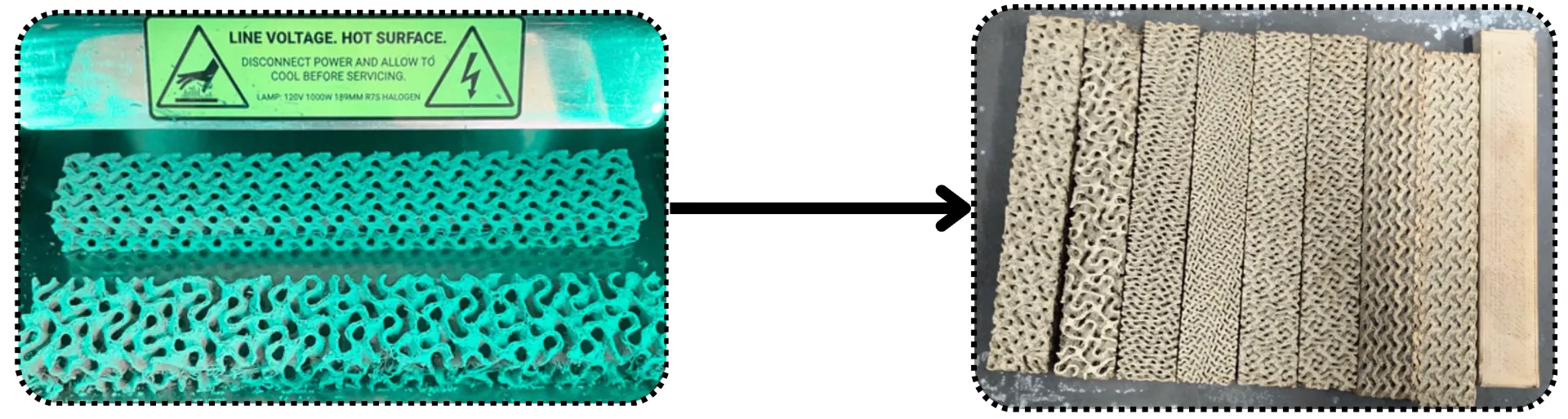
Twenty beams with different infill densities and patterns, from simple grids to gyroids, gave the models a spread of mechanical properties to learn from.
Acoustic emission testing
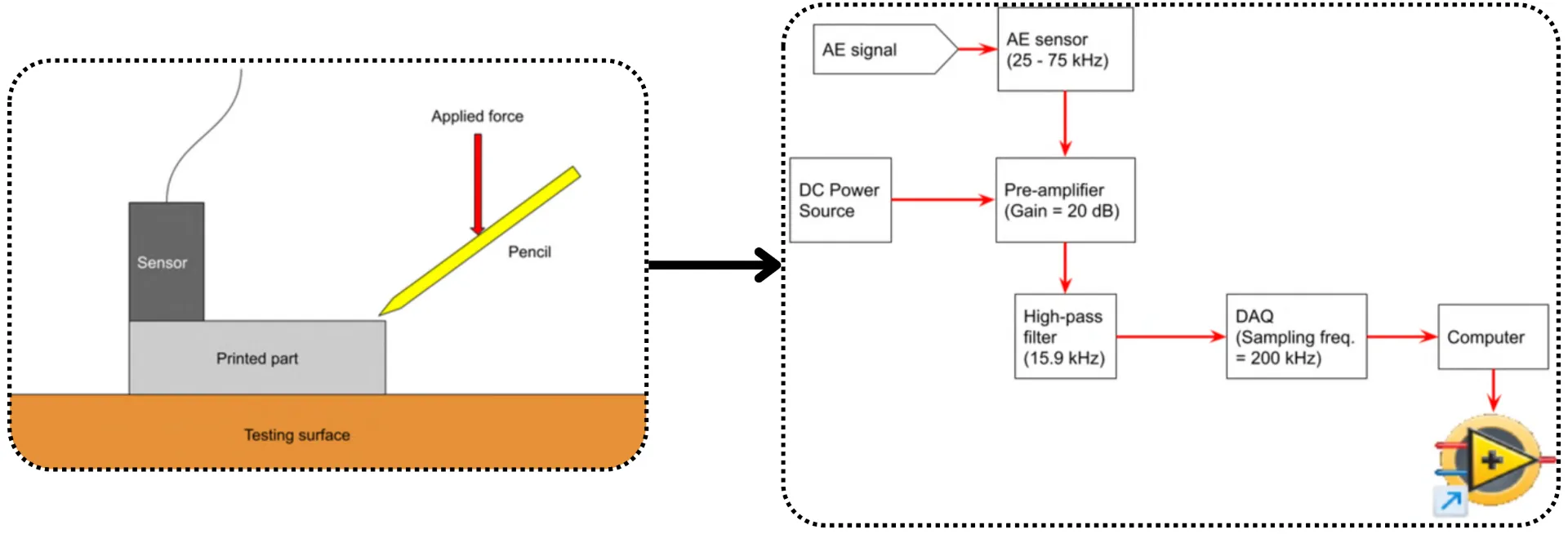
Pencil-lead breaks on the edge of each beam, done in a controlled and repeatable way, generated acoustic waves captured by a 25 to 75 kHz sensor at the far end. The signal was amplified, filtered and recorded at 200 kHz.
Ground truth
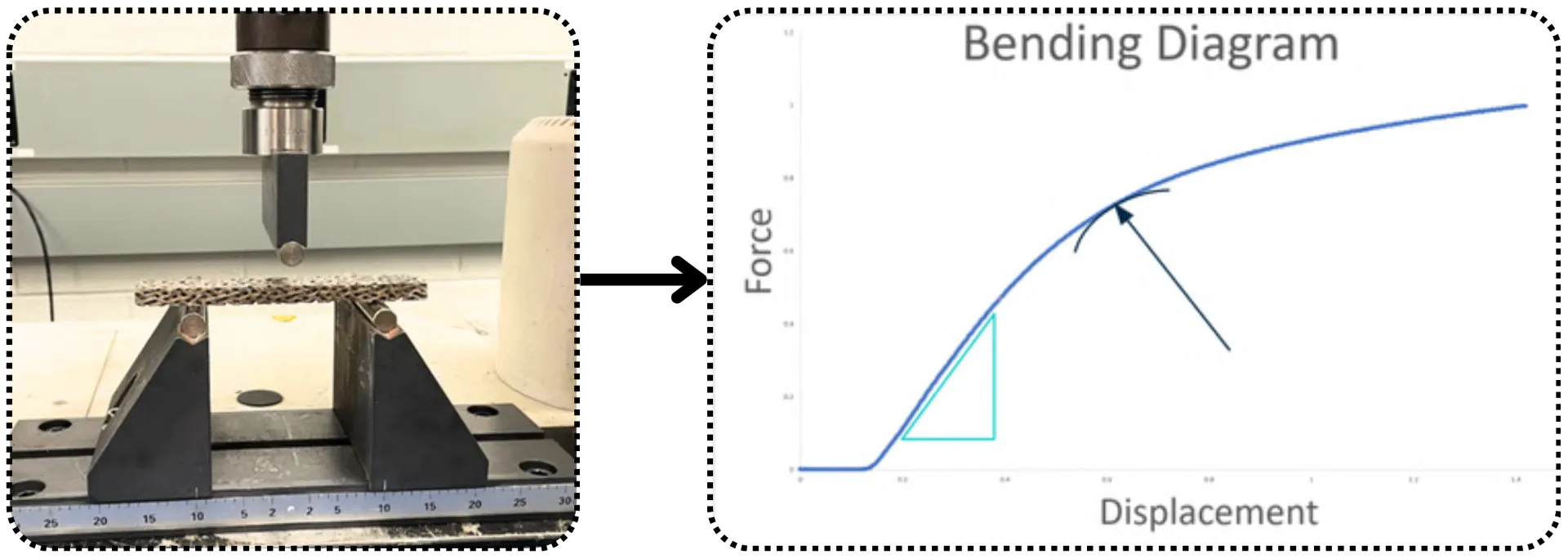
A three-point bending test on each beam gave the elastic modulus from the force-displacement curve, providing the target values for training.
Preprocessing
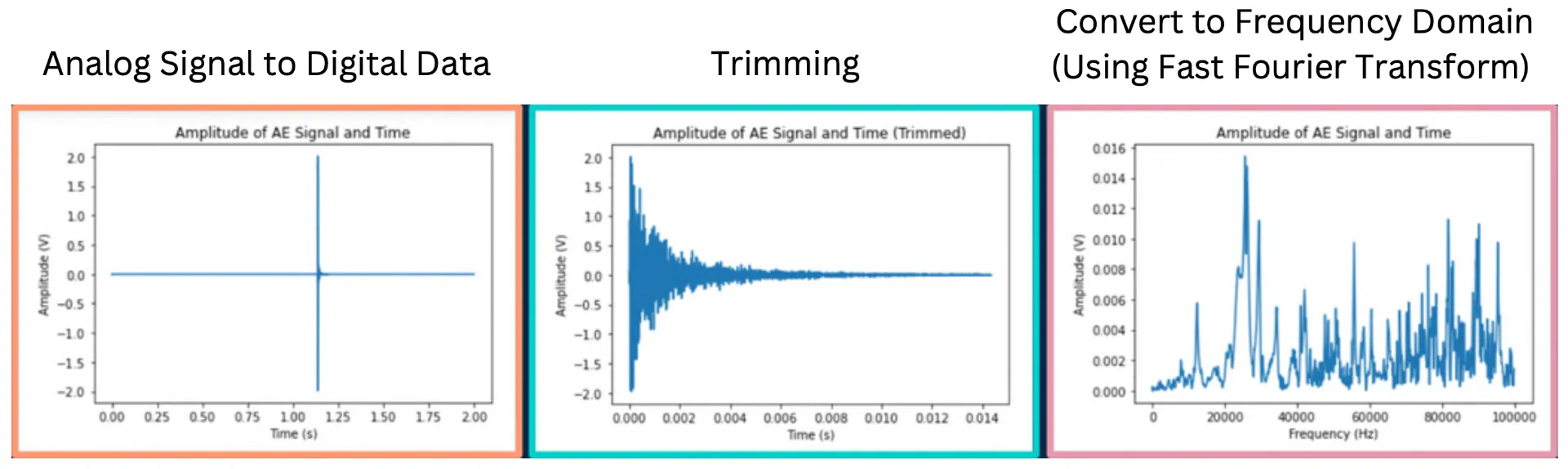
Signals were trimmed to the relevant window and transformed to the frequency domain with a fast Fourier transform. Frequency-domain features proved far more useful to the models than the raw time series.
Models
An artificial neural network (150 inputs, hidden layers of 300 and 150 nodes, one output) was compared against a random-forest regressor with 10 estimators. Both were trained on 80% of the data and evaluated on the rest.
Results
Both models gave useful ballpark estimates, but with higher error than hoped against the bending tests. Likely sources were ambient noise during acoustic testing, variation in the lead-break force and the small sample size. The project showed the approach is feasible and was a thorough lesson in data collection, processing and model development for materials work.